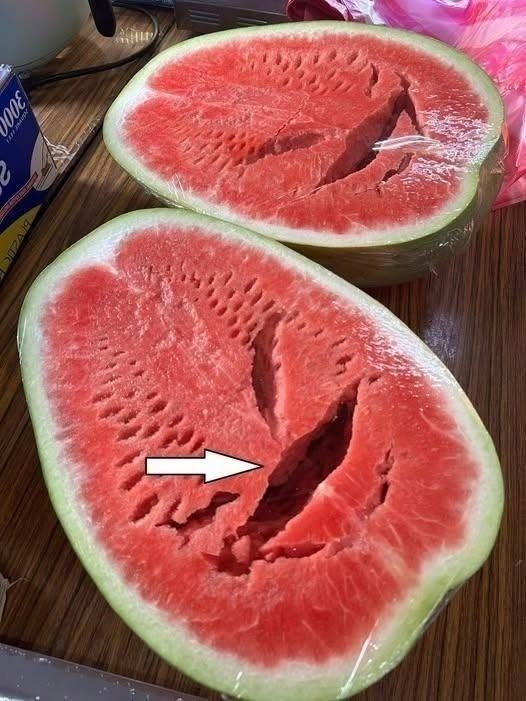
That warning is partially true, but it needs serious clarification.
If you cut open a watermelon and see deep, dark, and dried-out cracks running through the flesh (not just the rind), you should absolutely stop eating it.
However, if you see shallow, small, or sugar-induced cracks, the fruit is perfectly fine.
Here is the real, science-backed breakdown of what those cracks actually mean and how to tell the difference.
1. The “Stop Eating” Cracks (Membrane Separation / Internal Bruising)
If the cracks look dark, brown, dry, or spongy, and the flesh around them is translucent (watery) or mealy, you are looking at advanced internal breakdown.
-
What it means: The watermelon has either been overripe for too long, suffered internal bruising from being dropped, or experienced “hollow heart” (a physiological disorder where the inner lobes split apart).
-
The real danger: Once a watermelon cracks internally, bacteria and fungi enter through the rind and begin fermenting the sugars inside. While you won’t get a fatal toxin (like botulism) from a fresh-cut watermelon, eating this fermented, cracked flesh will give you severe food poisoning (nausea, vomiting, and diarrhea) due to high levels of yeast, mold, and opportunistic bacteria like Salmonella that thrive in the moist, sugary cracks.
-
The rule: If the crack is open to the air (you can see the outside rind through it) or the flesh is oozing liquid, throw it away immediately.
2. The “Safe to Eat” Cracks (Sugar Cracks / “Star” Splits)
If the cracks look shallow, light-colored, and dry, and the flesh around them is bright red and firm, you have hit the jackpot.
-
What it means: These are called “sugar cracks” or “star cracks.” They happen inside the watermelon while it is still growing on the vine. During the final stage of ripening, the fruit pulls in so much water and sugar so quickly that the internal flesh literally bursts from the pressure.
-
Why it’s good: These cracks are a traditional sign of an exceptionally sweet, perfectly ripe melon. The sugar concentration is so high that the flesh splits. In fact, many farmers in Asia specifically look for these “cracked” melons to sell at a premium.
The Ultimate Test (The “Sniff & Touch” Rule):
Don’t just look at the cracks—smell and touch them.
-
Safe: The crack is dry to the touch, smells sweet and fruity, and the surface is crisp.
-
Danger: The crack is wet, slimy, or sticky; the flesh has a dull, grayish tint; and it smells sour, alcoholic (like nail polish remover), or like rotten compost. That smell means fermentation has turned into putrefaction—throw it out and wash your knife thoroughly.
Bottom Line: Don’t panic over every crack. If it’s a dry, shallow “star” pattern, enjoy your extra-sweet melon. If it’s a deep, dark, wet canyon that smells like a winery gone bad, do not eat it.