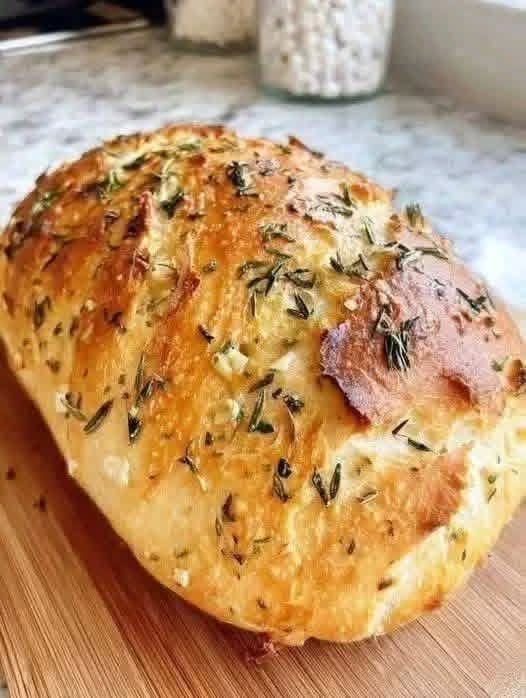
Rustic No-Knead Garlic & Herb Artisan Bread
A golden, crackly-crusted loaf with a soft, airy crumb—infused with roasted garlic and fresh herbs, finished with flaky salt. Minimal effort, maximum reward.
Yield: 1 round loaf | Active time: 20 min | Total time: 14–20 hrs (mostly hands-off)
Ingredients
For the dough:
-
3 cups (360g) all-purpose or bread flour
-
1½ tsp fine sea salt
-
½ tsp instant yeast (or ¼ tsp active dry)
-
1½ cups (360ml) lukewarm water (about 100°F/38°C)
For the topping:
-
4–5 cloves garlic, thinly sliced
-
2 tbsp olive oil
-
1 tbsp fresh rosemary or thyme leaves, chopped (plus a few sprigs for garnish)
-
1–2 tsp flaky sea salt (Maldon or similar)
-
Optional: 2 tbsp grated Parmesan
Method
1. Mix the dough (night before)
In a large bowl, whisk together flour, salt, and yeast. Add water and stir with a wooden spoon or spatula until a shaggy, sticky dough forms—no dry flour remains. It will look messy; that’s correct.
2. First rise (12–18 hours)
Cover the bowl with plastic wrap or a lid and let it sit at room temperature (65–72°F) for 12–18 hours. The dough is ready when it’s doubled, bubbly, and smells slightly yeasty and sour.
3. Prep the garlic & herbs
About 30 minutes before shaping, gently warm the olive oil in a small pan over low heat. Add the sliced garlic and cook until fragrant and just barely golden—don’t brown it or it turns bitter. Set aside to cool. (You can also skip the pan and just use raw sliced garlic + oil; it roasts in the oven.)
4. Shape
Turn the dough out onto a well-floured surface. It will be loose and sticky. Fold it over itself 3–4 times (letter-fold style), then gently shape into a round by tucking the edges underneath. Place seam-side down on a sheet of parchment paper.
5. Second rise (1–2 hours)
Cover loosely with a clean towel and let rise until puffy and nearly doubled, about 1–2 hours, depending on room temperature.
6. Preheat
At least 30 minutes before baking, place a Dutch oven (with lid) in the oven and preheat to 450°F (230°C).
7. Top the loaf
Brush the risen dough generously with the garlic oil, pressing some garlic slices into the surface. Scatter chopped herbs over the top, then finish with flaky salt and Parmesan if using. Lightly score the top with a sharp knife or lame—a simple cross or single slash.
8. Bake
Carefully lift the parchment and lower the dough into the hot Dutch oven. Cover with the lid and bake 30 minutes. Remove the lid and bake another 10–15 minutes, until deep golden brown and the internal temperature hits 200–210°F (93–99°C).
9. Cool
Lift the loaf out and cool on a wire rack for at least 30 minutes before slicing. The crust will crackle as it cools—that’s the sound of a good loaf.
Tips for Success
-
Wet dough = open crumb. Resist adding too much flour; a sticky dough gives those big artisan holes.
-
Longer ferment = more flavor. If you have time, push the first rise to 18 hours in a cool spot.
-
No Dutch oven? Bake on a preheated sheet pan with a metal bowl inverted over the loaf for the first 30 minutes, or place a pan of boiling water on the lower rack for steam.
-
Garlic safety note: If using raw garlic in oil, use it within a few hours or refrigerate—garlic-in-oil can harbor botulism if left at room temperature long-term. Pan-toasting it first avoids this entirely.
-
Herb swap: Rosemary is woodsy and robust; thyme is softer and more delicate. Both work beautifully—or use a mix.
Serving: Best the day it’s baked, warm with butter, or torn alongside soup, olive oil, or a sharp cheese. Store cut-side down on the counter for 1–2 days; revive slices in a hot oven or toaster.