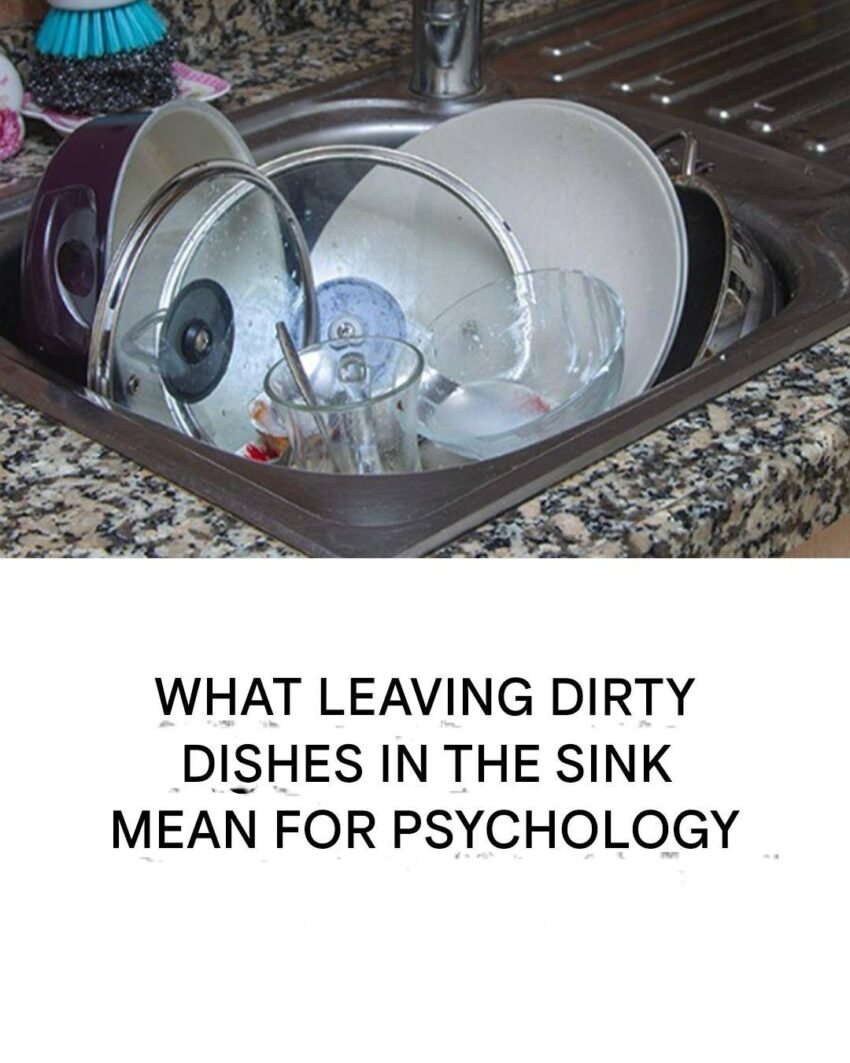
Excellent question. Leaving dirty dishes in the sink is a common behavior rich with potential psychological meaning. It’s rarely just about laziness, and more often a signal about a person’s mental state, relational dynamics, or environmental stressors.
Here’s a breakdown of possible psychological meanings, from the individual to the interpersonal.
Individual/Internal Meanings (For the Person Leaving Them)
-
Mental & Emotional Overload (The “Spoon Theory” in action):
-
Meaning: The dishes represent a demand on finite mental or physical energy. When overwhelmed by stress, anxiety, or depression, the simplest tasks can feel insurmountable. The sink becomes a visual pile of “to-dos” that the brain is actively avoiding. This is a classic sign of executive dysfunction, common in depression, ADHD, burnout, or chronic illness.
-
-
Decision Fatigue & Procrastination:
-
Meaning: The act of washing dishes involves a series of small decisions (rinse, scrub, load, dry, put away). For someone whose decision-making “muscle” is exhausted from work or other stressors, this micro-task feels like a final, unbearable demand. It’s often procrastinated with the thought, “I’ll do it later,” when mental capacity is hypothetically restored.
-
-
Boundary Setting & Autonomy:
-
Meaning: In a shared living space, consistently leaving one’s own dishes can be a (often unconscious) assertion of control and personal boundaries. It’s a way of saying, “I will manage my space and my responsibilities on my timeline, not on someone else’s demand or schedule.”
-
-
Unresolved Conflict or Resentment (Passive-Aggression):
-
Meaning: In a shared household, this can be a non-verbal communication of anger or resentment. It’s a way of expressing dissatisfaction without direct confrontation, forcing the other person to either address the underlying issue or “submit” by cleaning up the mess.
-
Relational/Interpersonal Meanings (In a Shared Home)
-
Unbalanced Labor & The “Mental Load”:
-
Meaning: This is often the core issue in partnerships. The person who routinely cleans the dishes may be carrying the invisible mental load of managing the household. The dishes left in the sink symbolize an inequality in perceived responsibility. It’s not just about the chore, but about who notices, cares, and takes initiative.
-
-
Testing or Seeking Care:
-
Meaning: For some (often unconsciously), leaving a mess can be a cry for help or a test of care. It can signal, “I am not okay; can you see my struggle and support me?” Alternatively, it can test the relationship’s tolerance and care-taking boundaries.
-
-
Differing “Clutter Thresholds”:
-
Meaning: People have different innate tolerances for disorder. A clash between a person with a high clutter threshold (doesn’t notice or mind dishes) and one with a low clutter threshold (feels stressed by visual chaos) is a fundamental compatibility issue, not a moral failing.
-
-
Weaponized Incompetence:
-
Meaning: When one person consistently performs a chore poorly or “forgets” to do it (like leaving dishes), they may be attempting to avoid future responsibility. The underlying message is, “You’ll get frustrated and just do it yourself, so I won’t be asked again.”
-
How to Address It Constructively
If this is causing conflict, avoid accusatory language (“You’re so lazy!”). Instead, use “I” statements and focus on the impact, not the intent.
-
Example: “I feel really anxious and overwhelmed when I come home to a sink full of dishes. It makes the kitchen feel chaotic to me. Can we talk about a system that works for both of us?”
-
Seek the Root Cause: Ask, “What’s going on when the dishes pile up?” Is it stress at work? Feeling unappreciated? Differing standards?
-
Create Clear Systems: Establish explicit agreements (e.g., “Whoever cooks doesn’t clean,” “All dishes are done before bed,” or “We run the dishwasher every night, full or not”).
Bottom Line: Dirty dishes in the sink are often a symptom, not the disease. They are a tangible clue to intangible states like overwhelm, inequity, resentment, or differing needs for order. Addressing the underlying psychological or relational dynamic is more effective than just fighting over the chore itself.